

Transform Your Mindless Scroll into Intentional Screentime
Unplug to Discover Yourself, and Find Your Competitive Edge

Are you online almost constantly, every day?
So am I, and 41% of Americans, according to a recent Pew Research study.
If it’s taking up so much of our day, then maybe it’s worth asking … what is the quality of the time we spend online?
We do a lot of impactful and meaningful things on our digital devices, such as organizing to connect in real life, collaborating, and getting inspired.
On the other hand, the infinite scroll has got us addicted to our screens. We know it’s not “good” for us to be glued to a screen all day, but so much of our modern lives demand it.
There is no shortage of opinions about how people ought to be living their lives online. From digital detox to ‘pics or it didn’t happen’, we’re caught in an often contradictory tangle of advice on how to balance our time online and off.
As a species, we are in the early years of adopting multiple, compounding revolutionary technological advancements. The internet, personalized content, and algorithms designed to optimize engagement have inextricably become part of our everyday lives within the last decade. It’s no wonder we’re questioning how to live well in response to such rapid change.
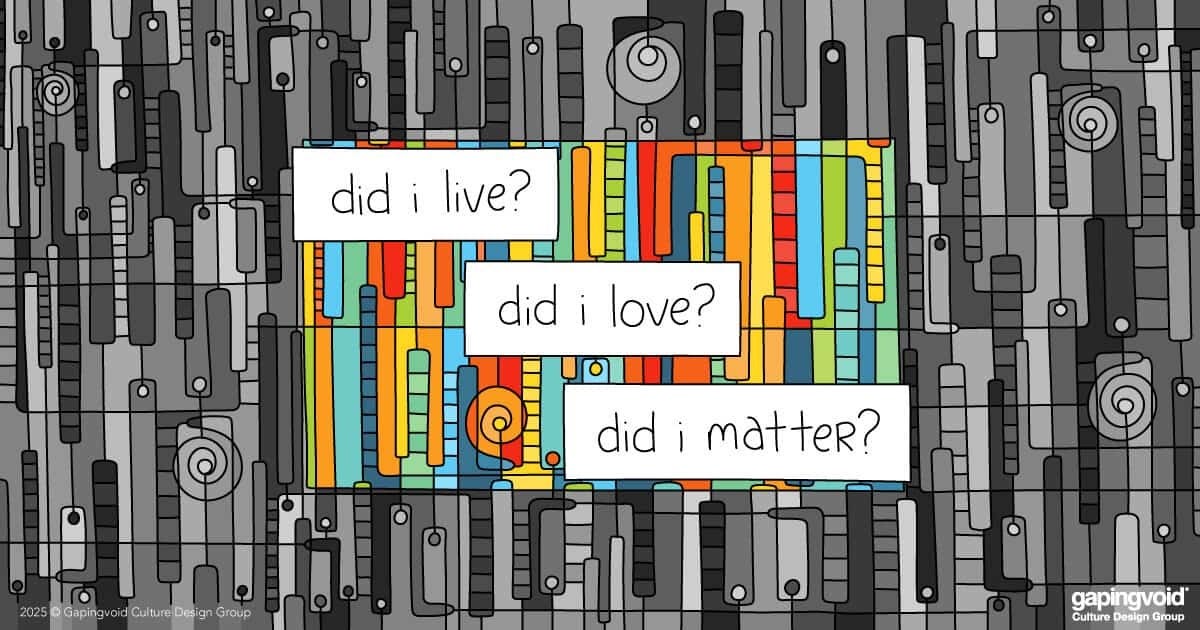
There’s no one right answer, but there is a lot to consider, including:
How did we get here?
How do we live a good (human) life?
What are some strategies for living well, today?
How do we make a living in a world that has transformed so dramatically, over such a short amount of time?
My (2,000-word) answer to these questions is equal parts labor economics, evolutionary anthropology, and purposeful tech use, with a dash of self-love.
Infinite Digital Consumables
In the opening line of his 2002 book, The Future of Success, former US Labor Secretary Robert Reich writes, “We are entering the Age of the Terrific Deal, where choices are almost limitless and it’s easy to switch to something better.”
Over 20 years later, it’s clear we are in this “Age of the Terrific Deal,” whereby the internet enables online commerce to make nearly every (physical) thing easily within reach of an effortless click. Books, clothes, cleaning supplies, groceries… Most material products in the global economy show up at our doorstep with two-day shipping.
But wait… there’s more! Today, we also enjoy unlimited access to digital consumables that have transformed our lives in ways no one could have predicted. With the effortless swipe of our phones, we enjoy the instantaneous delivery of hyper-personalized streams of entertainment. With a few keystrokes, chatbots confidently answer auto-generated quick-read summaries of any topic imaginable. These products keep us glued to our screens.
You Are the Product, Too
While we have effortless access to the best material and digital products of the global economy, we, as workers, are also subject to limitless competition. In other words, employers now have access to online marketplaces to find their best next hire, and you are just one of a multitude of highly qualified candidates.
Our commodification as workers is nothing new. After all, we live in a capitalistic economic system where we exchange our labor hours for money. However, what’s made the competition much more intense is that your boss can easily choose from a global marketplace of highly qualified laborers with the click of a button. Furthermore, the development of AI agents threaten to replace human workers with computer programs.
In this economy, spending your entire career climbing your way up a large organization can feel neither financially optimal nor secure. That insecurity might make you feel compelled to curate your LinkedIn to attract recruiters for a better job, or just over-working at your current job so you don’t get replaced by another highly qualified candidate (human or not). This, of course, translates to more time online.
Constantly being online has its costs, however. In this digital world, we have reduced our bodies, along with our complex ideas and values, into bytes and pixels bought and sold in the attention economy. We have replaced face-to-face human interaction with the exchange of disembodied digital representations of ourselves.
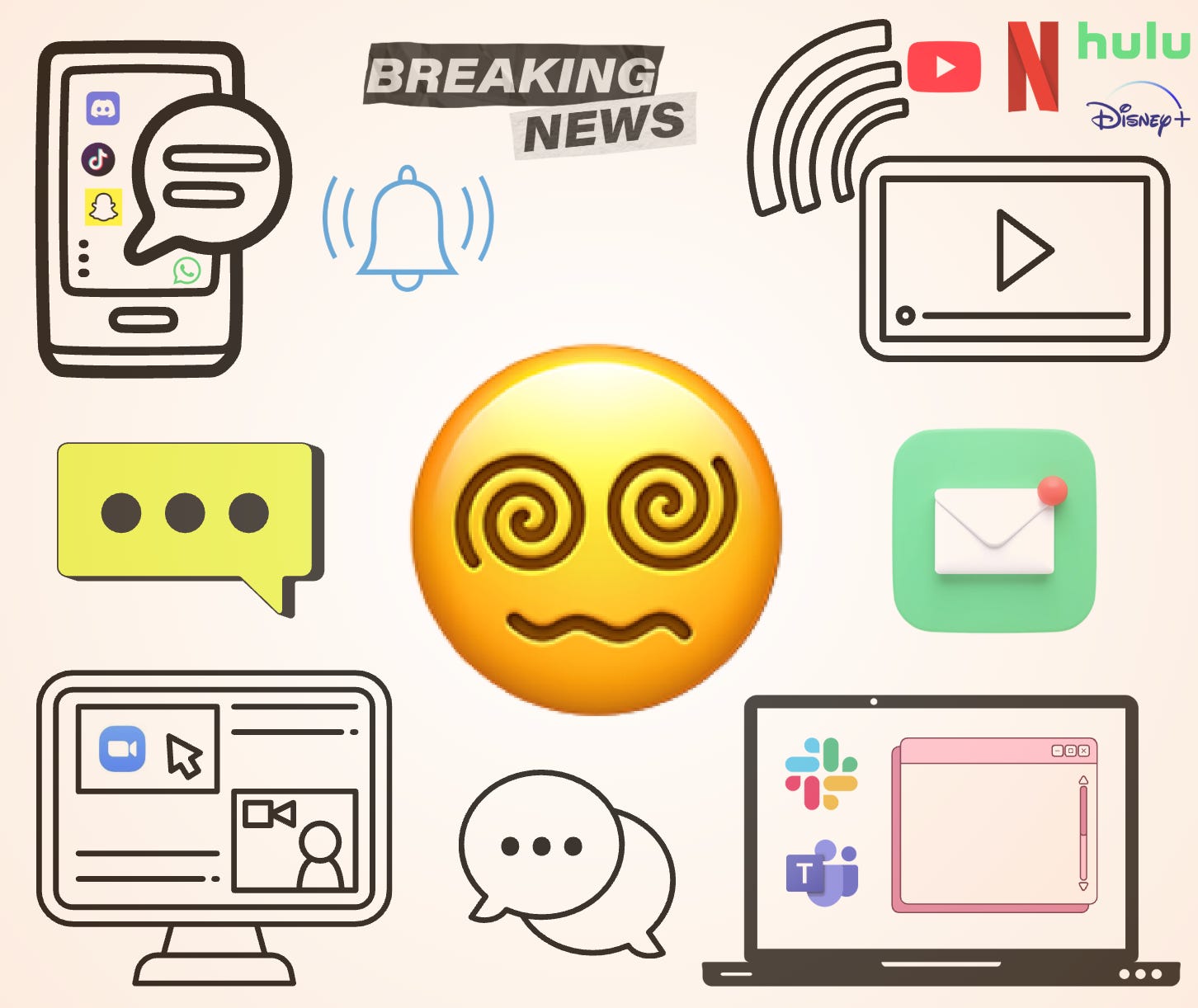
In the book, Technofeudalism: What Killed Capitalism, Yanis Varoufakis explains, “Cloud capital has shattered the individual into fragments of data, an identity comprised of choices as expressed by clicks, which its algorithms are able to manipulate.” Instead of embodied, face-to-face interactions, many of us spend most of our days interacting with other people mediated through a screen. These interactions are harvested and manipulated by large tech companies that profit from this online activity. To an observer from the not-so-distant past, this behavior would be unrecognizable as human socialization.
What Makes Us Human?
The modern human, Homo sapiens, has been around for about 200,000 years.
Most of us have used the internet for about 20 years.
It’s no wonder that excessive time spent on addictive online activities such as social media use are associated with an increase in depressive symptoms and greater irritability.
We didn’t evolve to live like this.
The first humans and people today share the following characteristics:
Our bodies: We walk on two legs and have larger and more complex brains than other primates.
Participation in social groups: We share resources, care for each other, contribute to our mutual survival, and cooperate to overcome challenges.
Communication & creativity: We speak to communicate and express ourselves through art.
Interaction with the environment: We create tools from materials in our environment, and change the world around us.
Despite these commonalities, our lives are clearly very different from those of our ancestors. The way we use our bodies, socialize, communicate, and interact with the environment have rapidly changed over the last few decades.
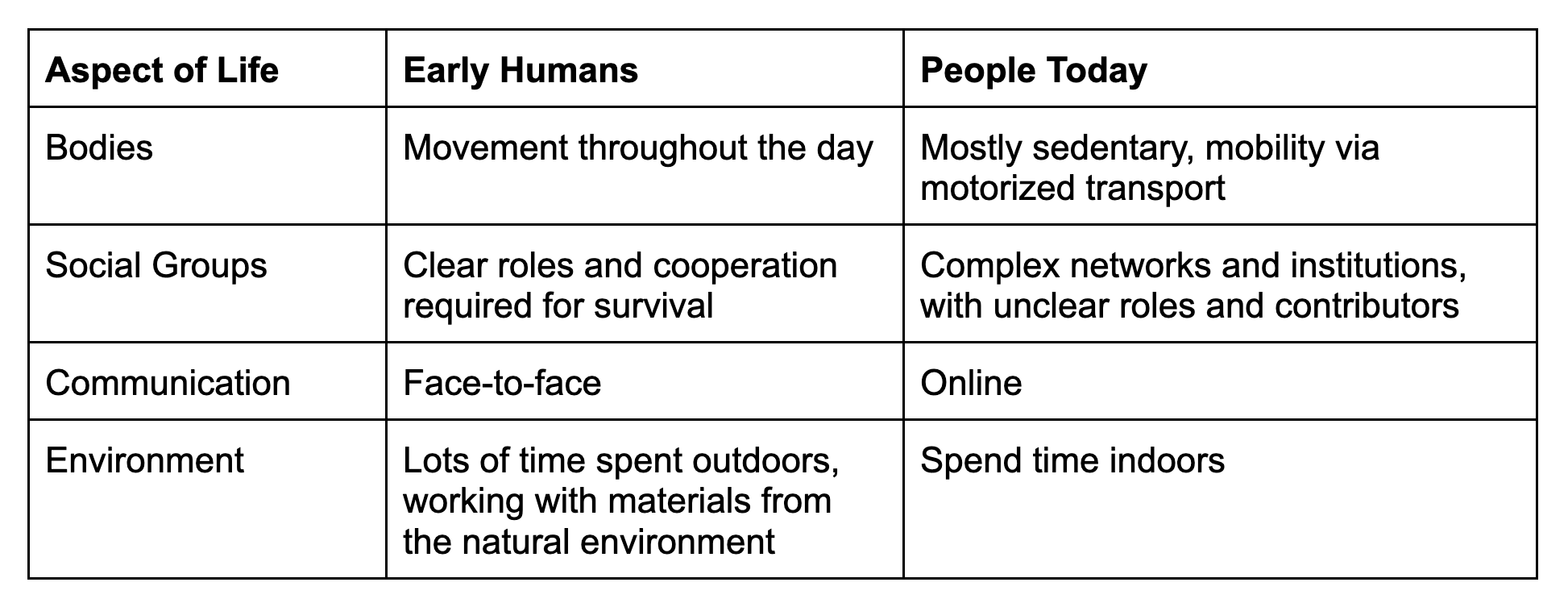
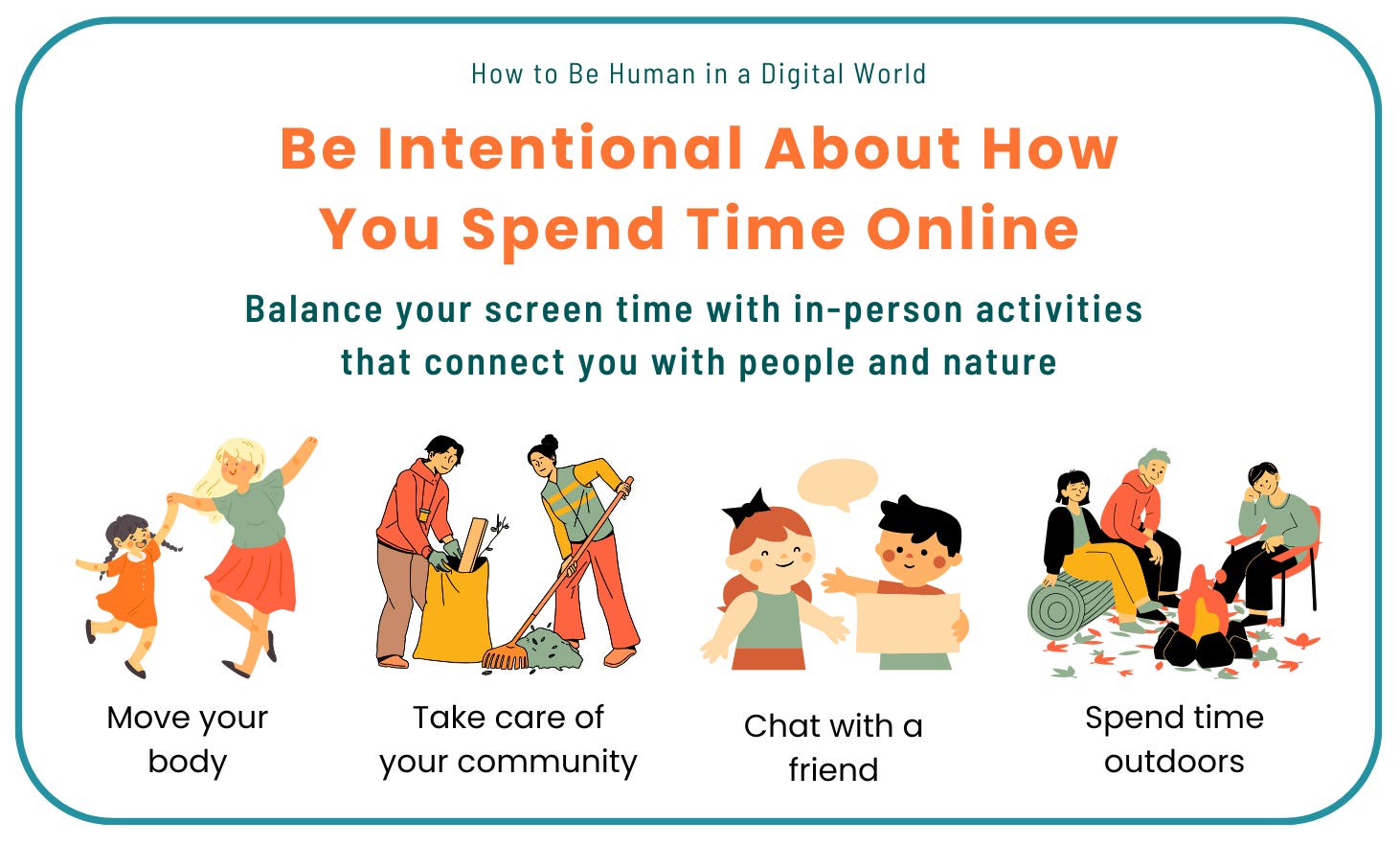
The early human evolved traits that made it advantageous for them to survive a challenging natural environment. Today, the modern human is mostly shielded from natural dangers, thanks to the conveniences of housing, energy, and food distribution. Yet, there are still many problems to solve in the world, and thankfully it’s still in our nature to want these things — movement, meaningful collaboration, face-to-face communication, and connection with our natural environment.
Looking to Nature for Inspiration
Perhaps we’d like to live a life that bears a little more semblance to our ancestral past. However, there are so many currents pushing us back to our screens at every moment of the day. Any attempt to fight it feels like swimming upstream.
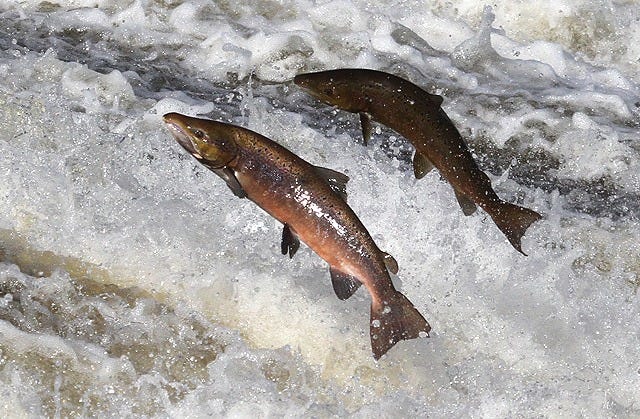
We can turn to nature for inspiration, which is full of examples where organisms beat the odds to live life in their own spectacular and unique way, to live as they were meant to. One of my favorite ones is the story of the salmon run.
When salmon reach maturity, they leave the ocean and start swimming up the rivers where they were born. This is a treacherous journey, where they traverse hundreds of miles in length and climb thousands of feet in elevation back to a precise location within meters of where they themselves once hatched. Many do not survive the exhaustion of swimming against strong currents, or predation from other animals. Those that do reach home will build nests, lay eggs, and protect them. Young salmon hatch, and they make their way back out to the ocean. The lifecycle starts anew.
We, too, can swim against the current to live purposeful lives.
Embrace Your Techno-Nostalgia
To live a life more attuned with our human nature, we can look to a time when the default mode of living was less digitally inclined… if you’re old enough. After all, the internet has only been widely used for about 20 years, when broadband enabled it to be always on. For millennials and older, we can access that time in our memories. It’s a luxury we take for granted.
People born after 1995, or Gen Z and younger, are known as the first “digital natives,” people who grew up with a fluency in digital technology from an early age. However, all the time they’ve spent online has come at a great cost. In The Anxious Generation, social psychologist Jonathan Haidt studies the ways social media use led to a precipitous decline in mental health among adolescents in the early 2010s, as measured by the more than doubling rates of depression, anxiety, self-harm, and suicide. One Gen Z writer expresses a longing for a time she never knew, a time when youth had “the freedom to grow up clumsily; to be young and dumb and make stupid mistakes without fear of it being posted online.”
All of those awkward moments, the stumbling through life and leaning on our closest friends and family to nurture us out of despair, are how we developed emotional and psychological resilience. Imagine replacing that with the endless scroll of comments and TikTok.
What would that do to you?
What has it done to you, and a generation of youth?
Living a little more like an early human, more IRL and less online, is how we live well.
So, how do we live in healthy balance with our digital world?
Single Purpose Electronics
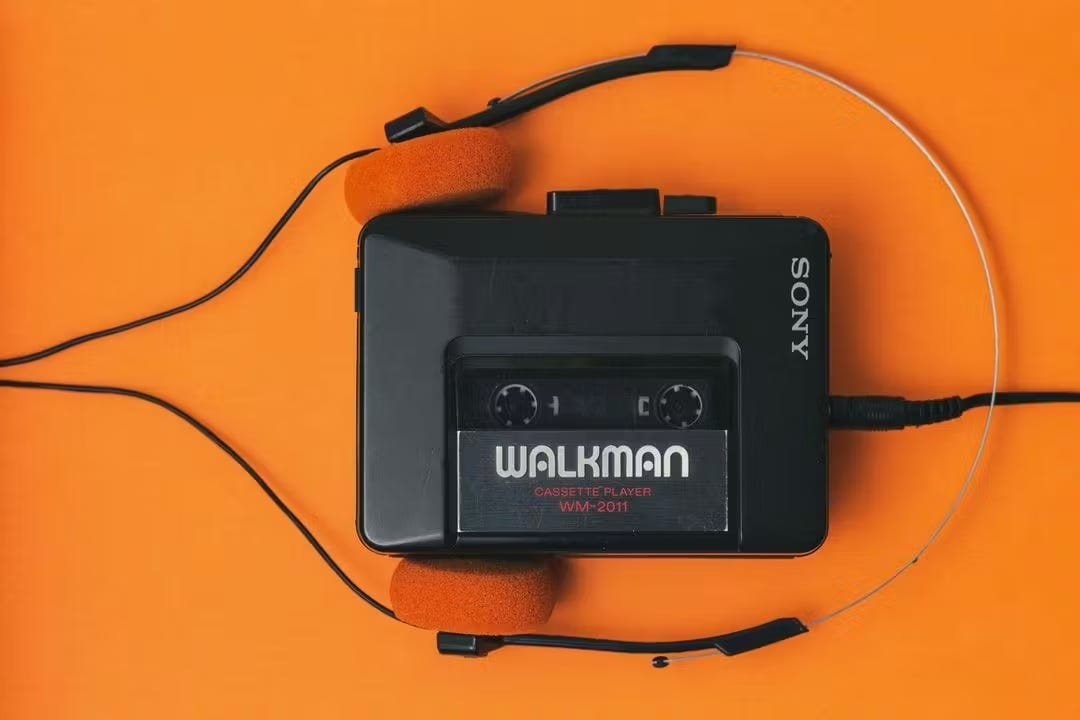
Remember the Walkman?
Depending on your age it might have been a portable radio, or Discman, personal MP3 player (iPod / Rio / Zune).
What these devices all have in common is they are all single-purpose devices.
They were all made to do just one thing: play music.

Over time, these single-purposes devices were combined into one everything machine. Nowadays, nearly every personal electronic device is an everything machine. Our smart phones, watches, tablets and computers lack a defined purpose. In fact, the vague primary aim of many applications we use is to keep us engaged, as long as possible, so they can sell your eyeball time to advertisers.
What if we assigned a specific purpose to each of our devices?
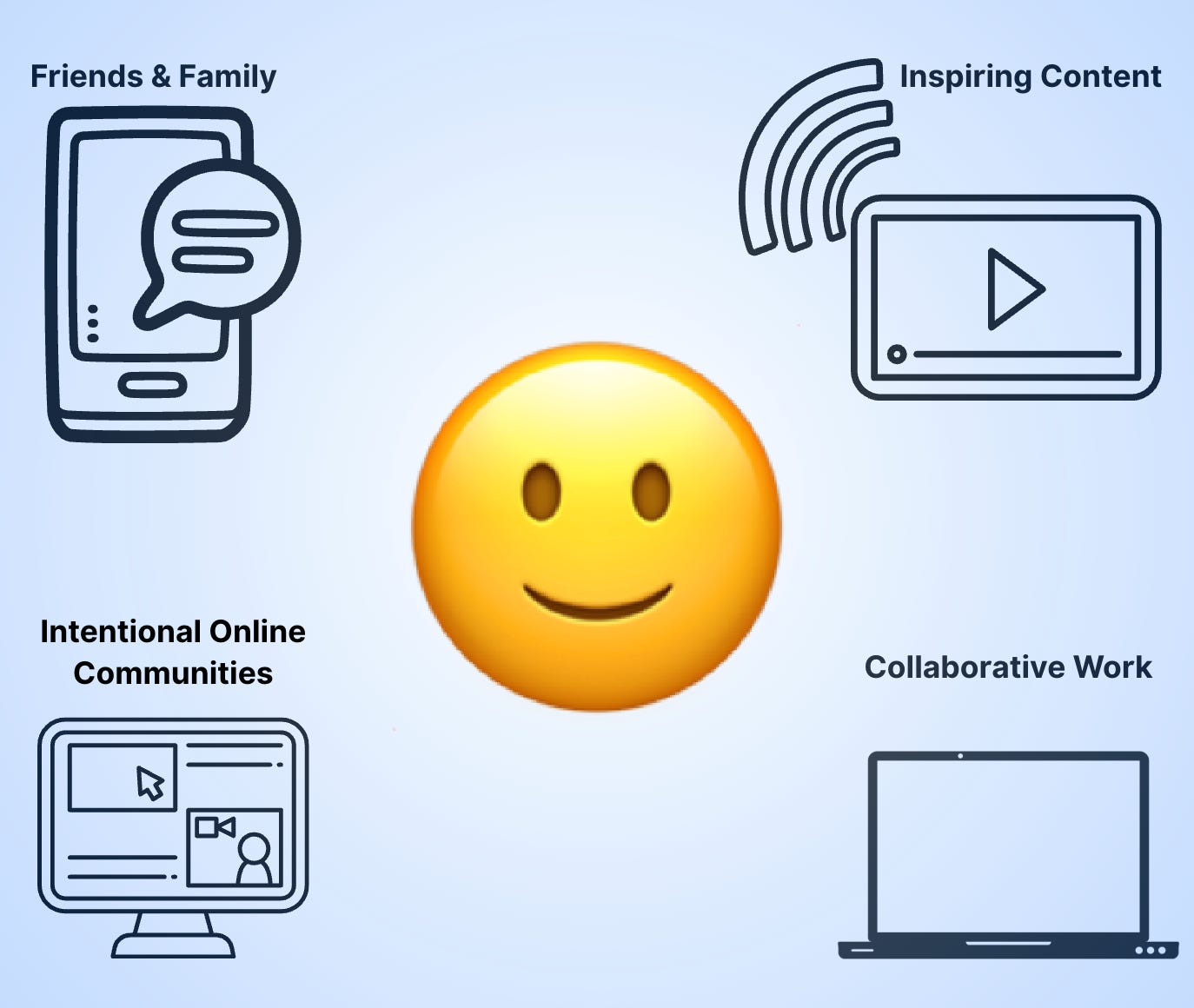
It could look something like this:
Use phones for communication - connecting with friends and family by phone calls and text, sharing photos via messages, video calls with loved ones
Tablets reserved for streaming videos
Desktop computer for connecting with community, household management
Laptop for work projects
Some aspects of this would be annoying, like if your browser tabs aren’t synced between your phone and computer browsers. That’s kind of the point, though. It would introduce positive friction to your digital life. The annoyance is exactly what you might need to interrupt the endless scroll, and what could help us live more intentionally.
Graphic designer and digital consultant, Christopher Butler puts it this way in his blog, Single-function devices in the world of the everything machine:
Sometimes what we gain in convenience, we lose in engagement. The friction of switching between different devices might have been — and remains — inefficient, but it created natural boundaries between different modes of activity. Each device was a doorway to a specific kind of experience, rather than a portal to endless possibility.
Establishing some boundaries between activities is just one of many examples of ways to live in balance with our devices that can help us thrive in this digital world. (For other ideas, check out Catherine Price and her work on Screen/Life Balance.)
The Opportunity of Today’s Economy
Modern society has undergone a digital transformation in recent decades. Governments, corporations, and schools digitized their records and have moved their operations onto computer-based systems. As a result, nearly every aspect of our lives requires us to be online. You can’t get through school, apply for a job, or pay bills without access to the internet.
It’s unavoidable that you have to go online to navigate modern life, but you always have the choice of how you spend your time online.
Even though we have access to limitless products, tangible and intangible, we don’t have to consume them all. Furthermore, it’s imperative that we recognize the cost of consuming more than we intend to.
Many of us feel compelled to spend more time online to attain economic security in this highly competitive global economy. Whether it’s putting extra hours in for work, or curating your online presence to land a higher paying job, it all feels necessary to stay ahead.
However, the reality is, in today’s economy conforming to the standards of established corporations is less secure than ever before. Business is increasingly conducted by contracts between smaller more agile businesses. While this shift can be unsettling for the salaried worker, it does create a different set of opportunities.
It opens the possibility of more optimal, and potentially weirdly magical, partnerships.
As Seth Godin writes about his book, We Are All Weird:
When we can connect everyone, customize and optimize–then what happens to normal?
Normal is so ingrained in what we do every day that it’s difficult to notice that your tendency toward the normal is now obsolete.
This book is personal, heartfelt and urgent. I hope that you’ll take the time to read it. In the words of the philosopher Dr. Seuss, “We are all a little weird and life’s a little weird, and when we find someone whose weirdness is compatible with ours, we join up with them and fall in mutual weirdness and call it love.”
Following your inner compass, swimming upstream to find your way home, and living as you were uniquely made to be, is your edge to someone in this economy of limitless choices.
You just need to tune out the (mostly digital) distractions to figure out what that is, so you can be the very best version of your true self. As more and more of us live out that dream, we can collaborate to create the innovations the world desperately needs.
As Mary Oliver reminds us in her poem, Wild Geese, we need to love ourselves, share our despair with each other, and remember our connection to the natural world. Everything else will fall into place, as it has for millennia, and will continue to do so for many more.

Grace Kim, PhD is a data and AI consultant helping organizations navigate technological change. Learn more about her work at mappinginsight.com.
Acknowledgements
Nicole Williams, writer/editor, for editorial review of this post and supportive writing coaching. Check out her environmental journalism on Substack and MuckRack.
Check out Substacks from leading voices on the topics covered in this article:
Robert Reich, professor, writer and labor economist
Jon Haidt, professor and social psychologist
Catherine Price, and her excellent resources on Screen/Life Balance
Seth Godin, whose books have inspired me to embrace my weird self and persist through the dips.
Love it. I’m just a personality making choices expressed through clicks. I feel so manipulated…